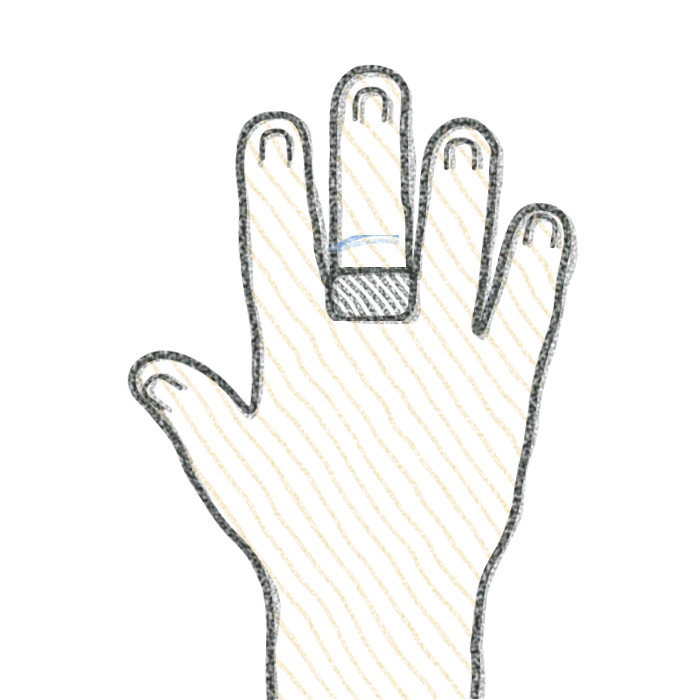
The Oura Ring 4 is a titanium ring that reads the finger with light, heat and motion, and turns a night of readings into a sleep score, a readiness score and some fifty other measures. It is made in sizes 4 to 15, weighs between 3.3 and 5.2 grams, and in India it costs ₹28,900, with a membership of ₹599 a month for most of the insights.
- 2.88 mm thick and 7.9 mm wide, titanium inside and out
- 17.5 mAh cell in the size 7 ring
- 18 light paths through the finger, up from 8 in Gen 3
- 0.25 W drawn from USB while it charges
The Shell
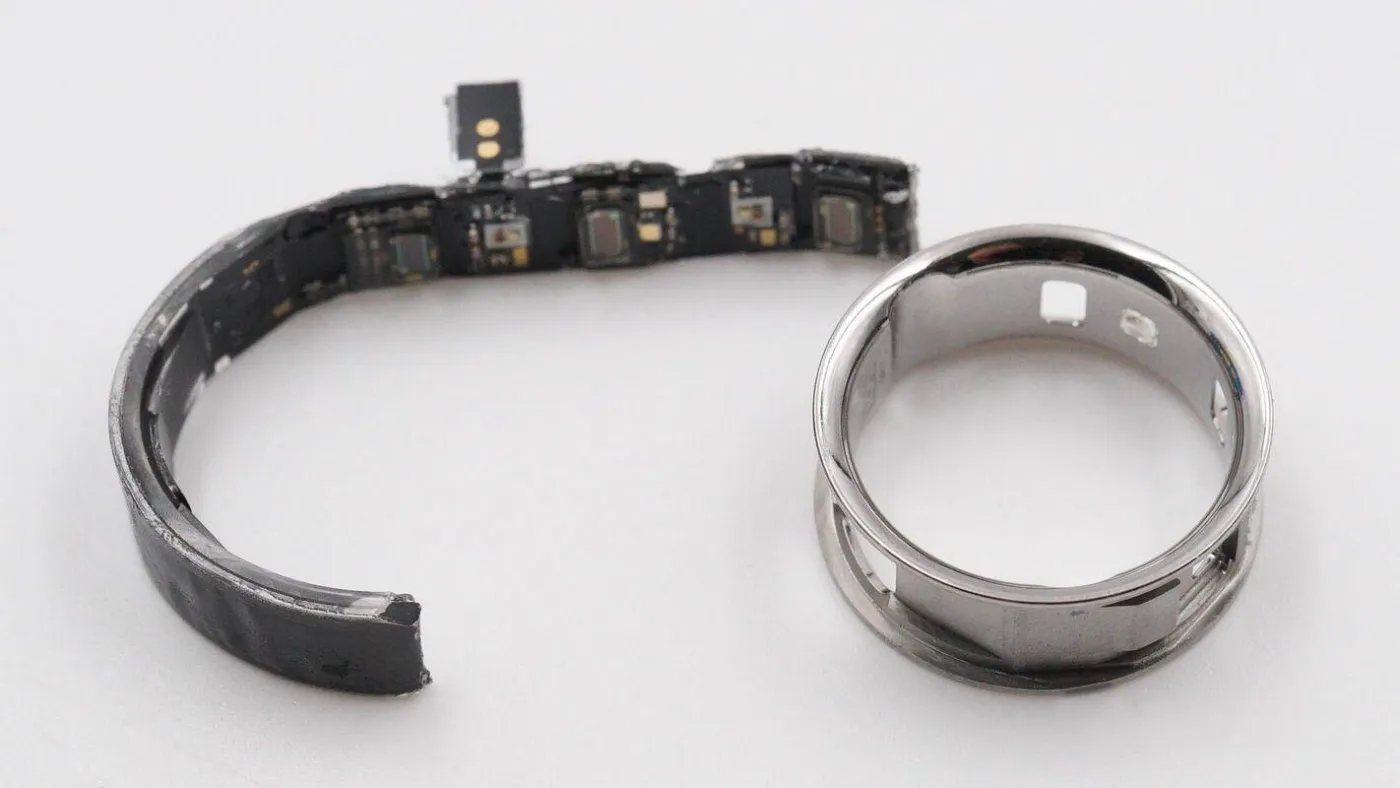
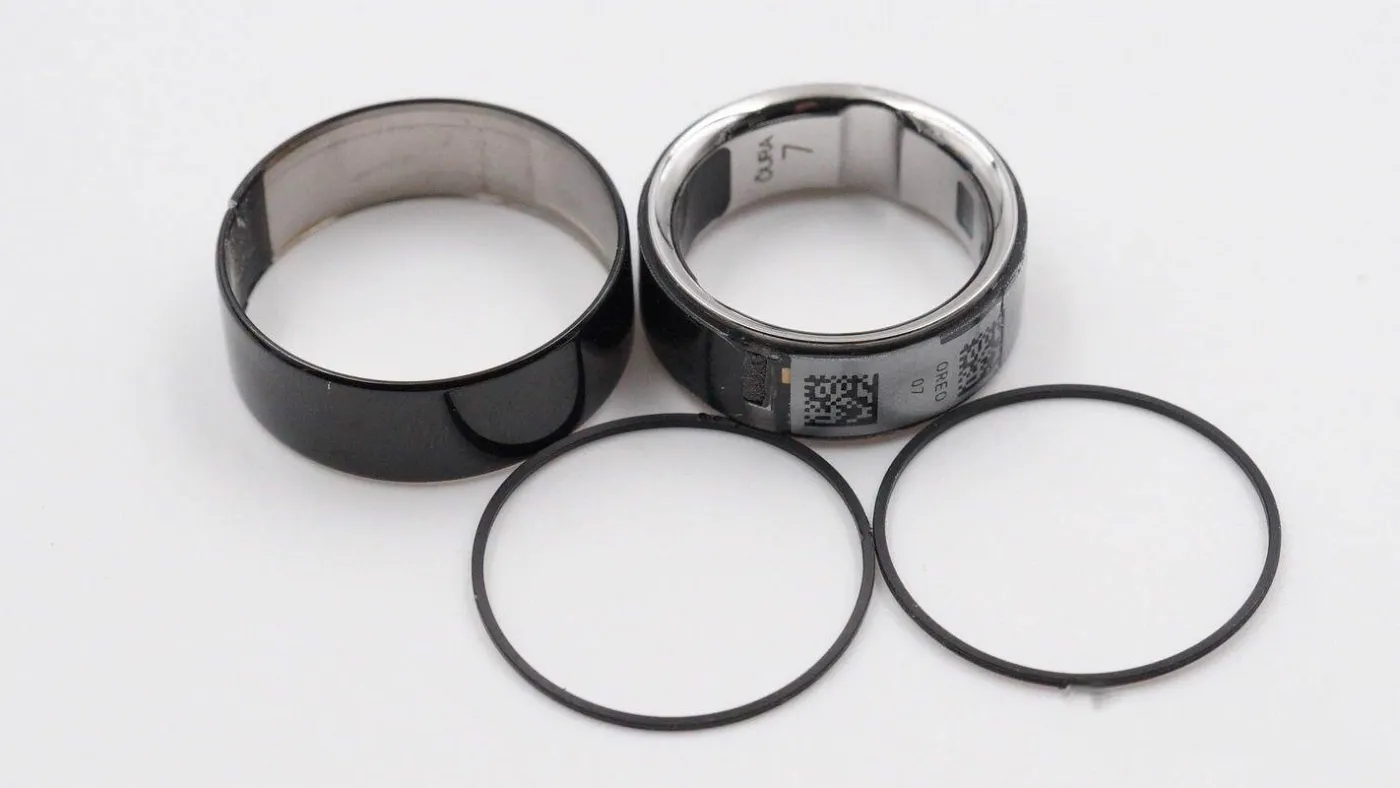
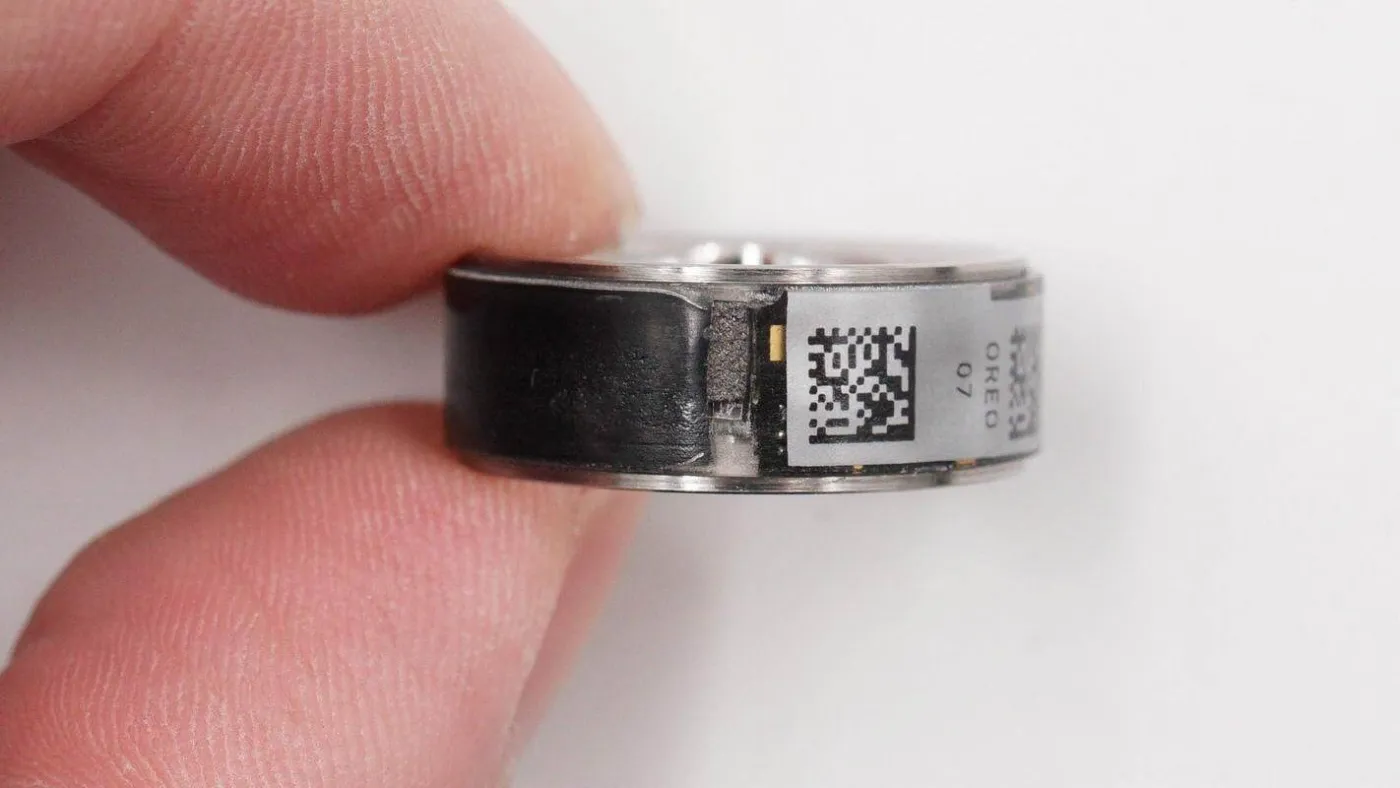
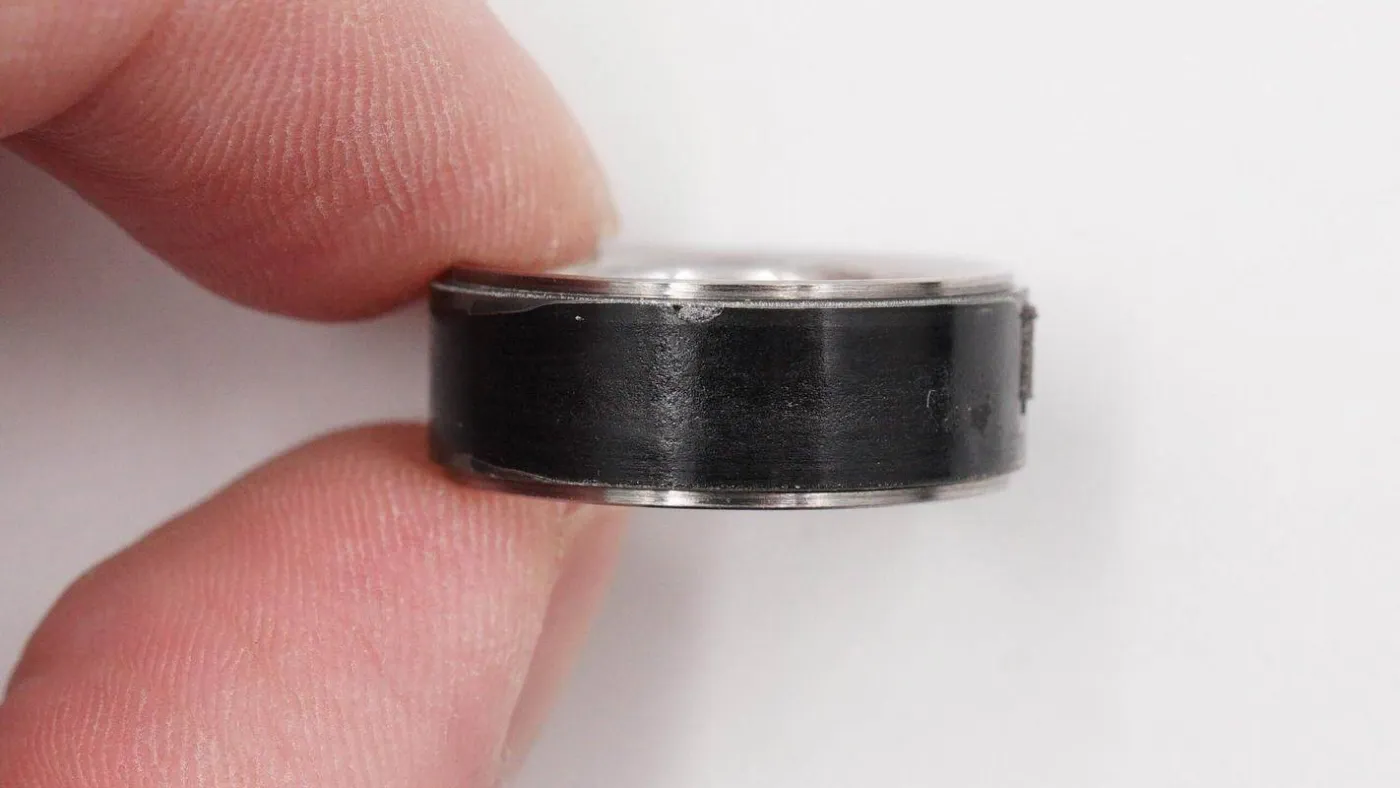
The ring is built like a sandwich. An outer titanium shell and an inner titanium shell are held a fraction of a millimetre apart, the circuit and battery sit in the gap, and the gap is filled with resin so that nothing moves and no water gets in. A thin plastic ring at each edge locks the two shells together; once those are cut away, the shells slide apart.
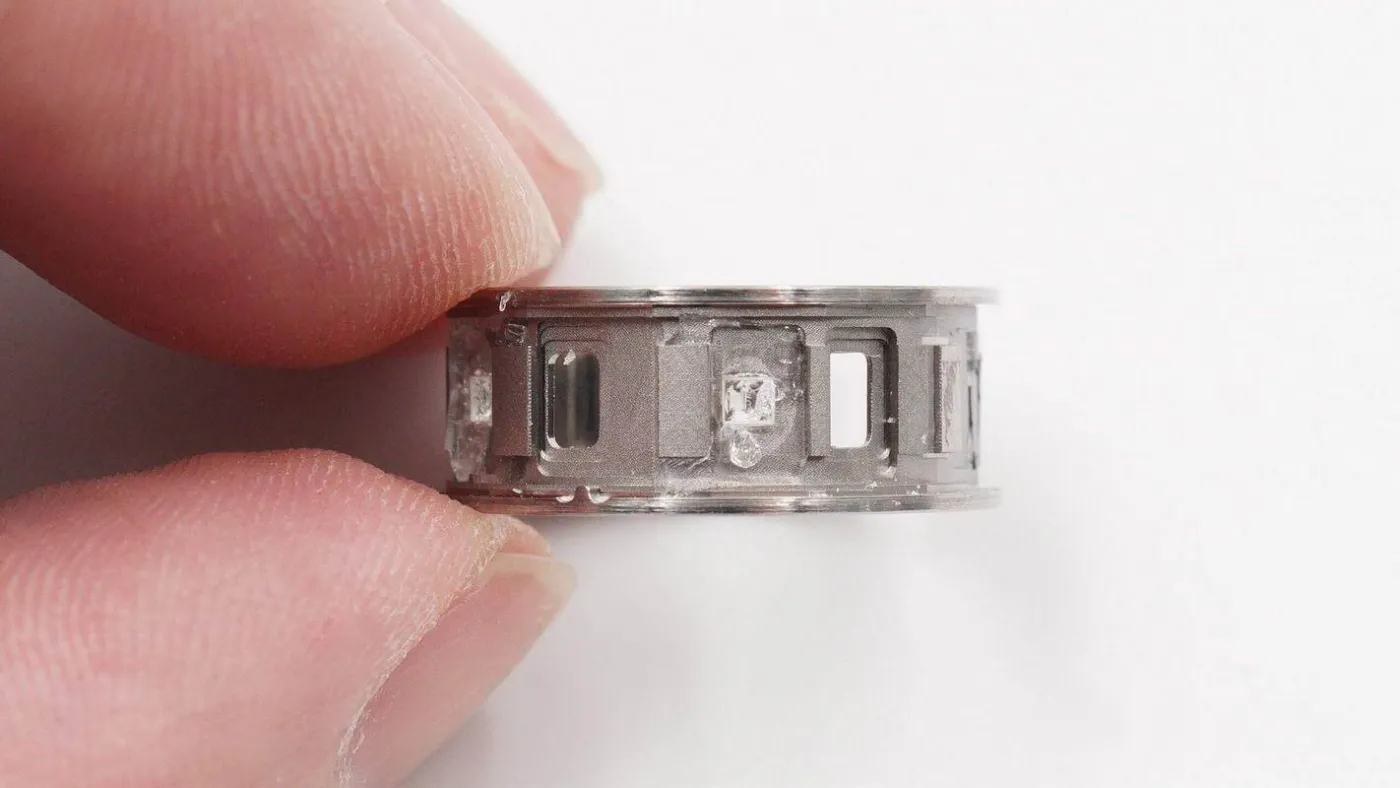
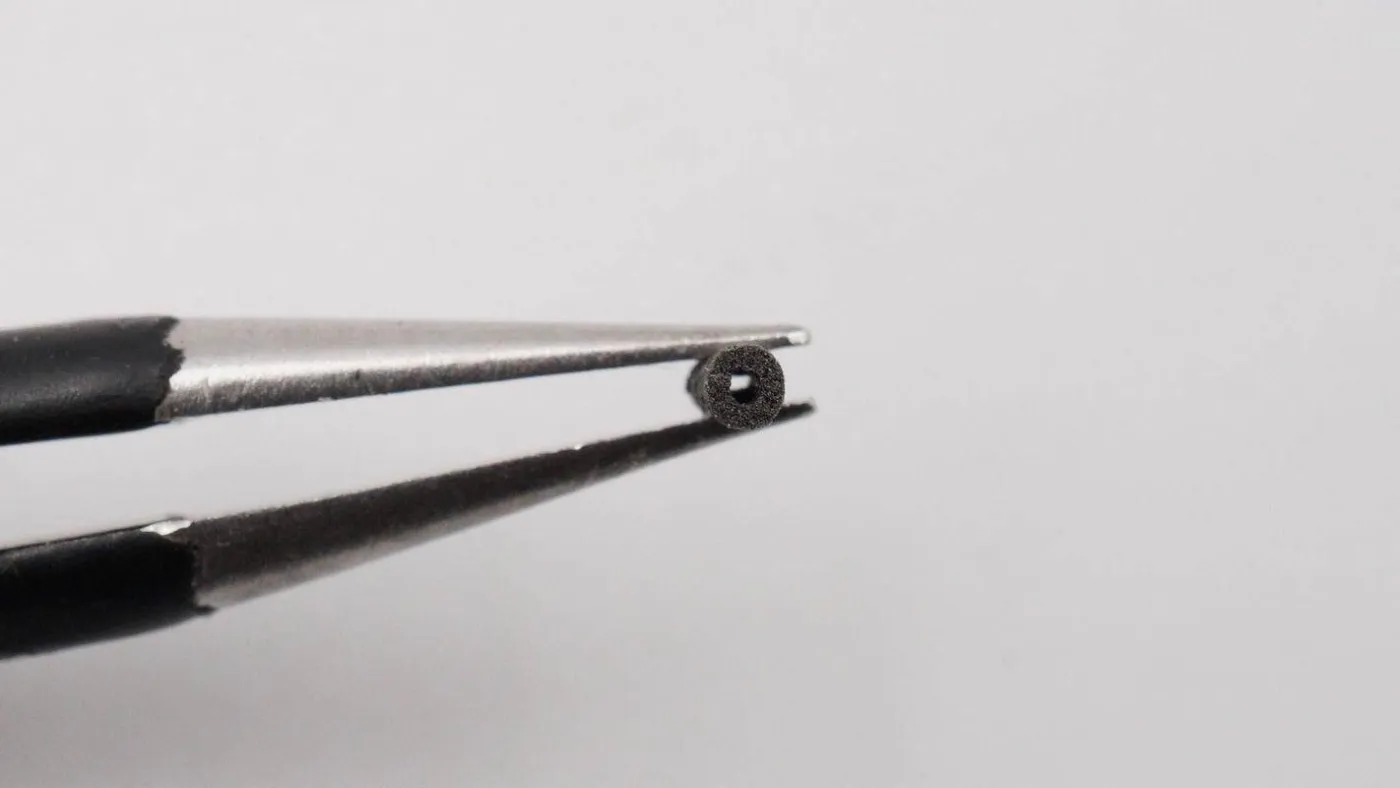
The inner shell is cut through with windows for the lights, the detectors and the charging coil, each filled with clear resin and set 0.3 mm back from the skin, where the Gen 3 ring had raised domes. Between the circuit and the battery, 52audio found short hollow tubes of foam, which take up the space that changes from one ring size to the next, so that one circuit can serve every size.
The Flex Circuit
All the electronics sit on one strip of flexible circuit, which curls around the inside of the ring with the battery on the opposite side. The side facing the finger carries the optics in a row: three light detectors, with a multicolour LED between each pair. The other side carries the chips, a row of numbered gold pads for testing at the factory, and the two pads where the battery is soldered on. A short tail with two contacts, left for testing, folds back over the outside of the circuit under the ring’s label.
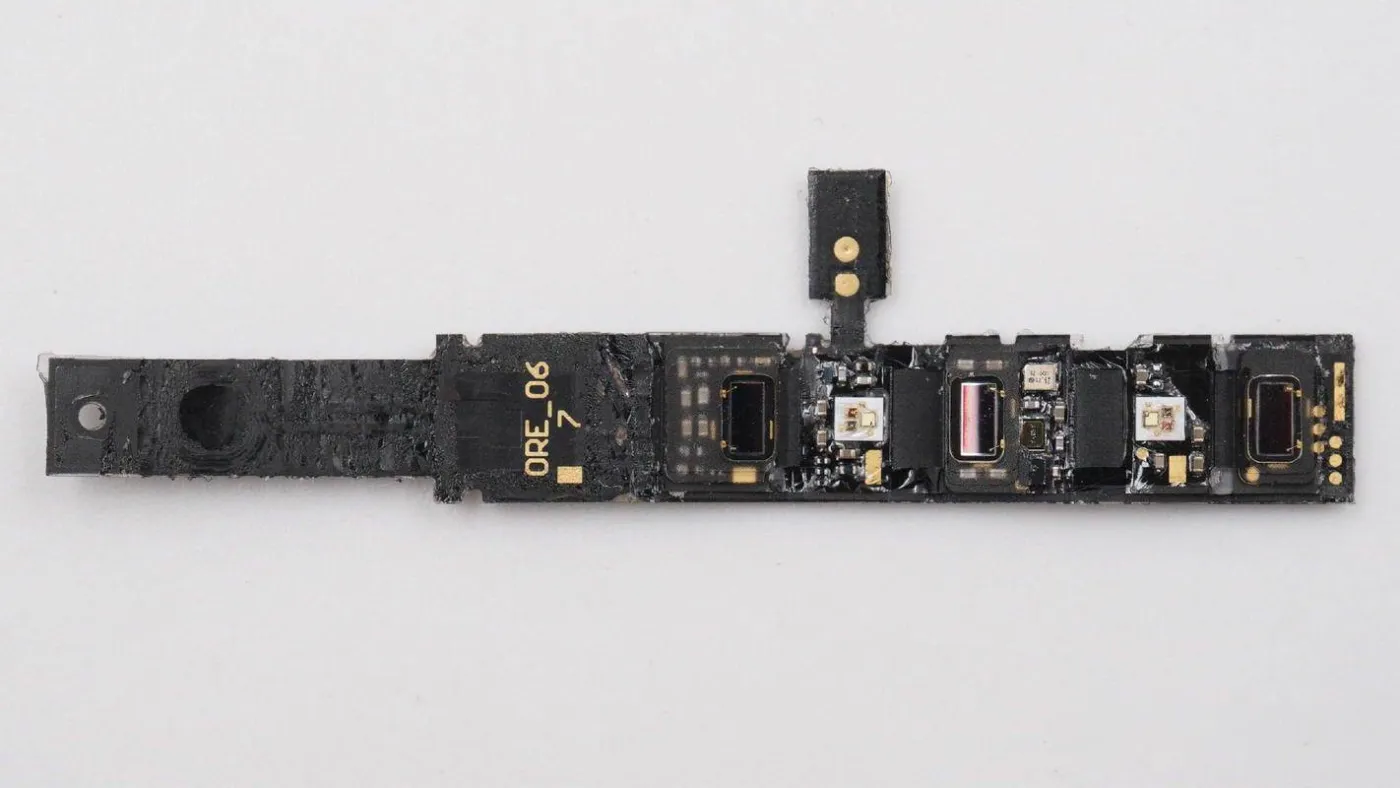
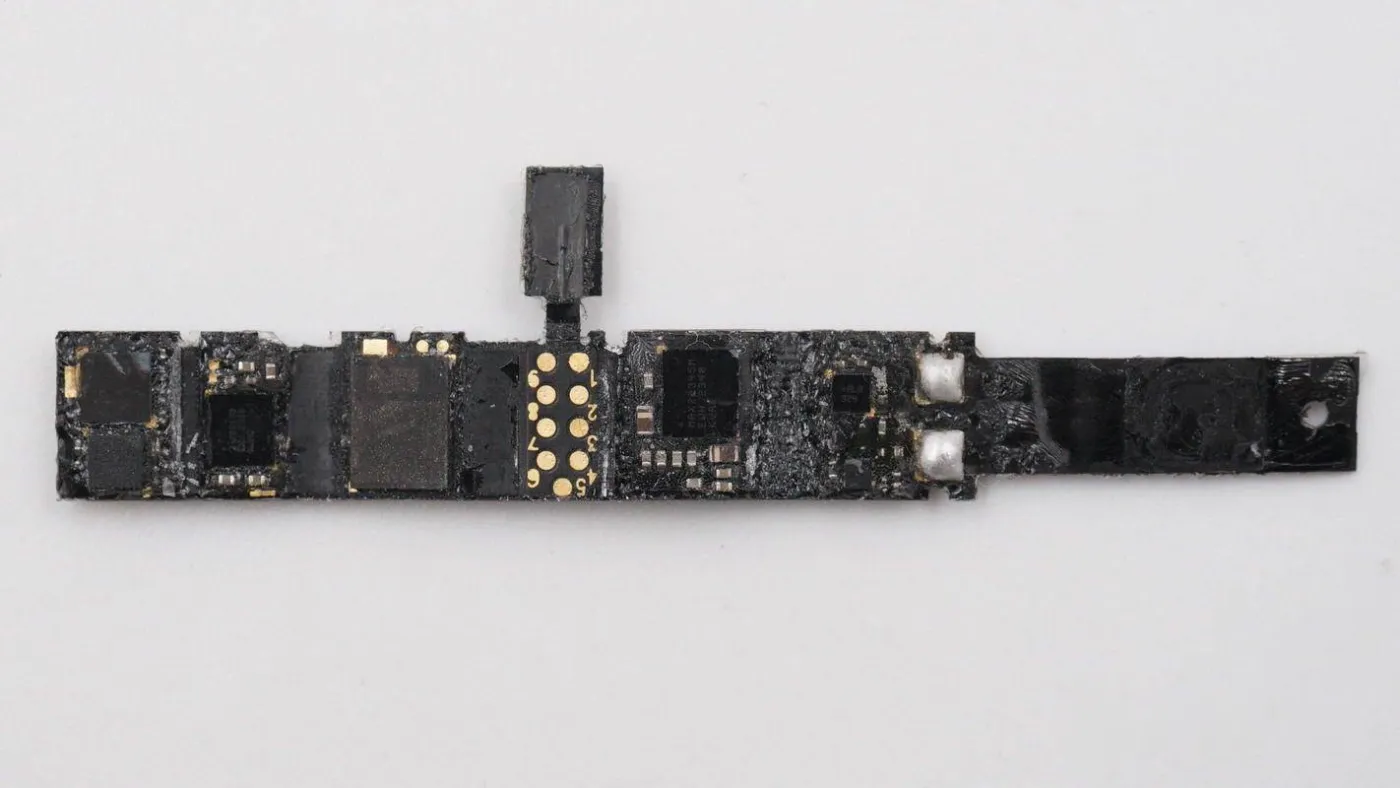
The board is marked ORE_06. Inside the Oura app, the firmware for the fourth-generation ring is filed under the name “oreo”, which suggests the marking is the ring’s internal codename and this is the sixth revision of its board; the charging dock’s boards are marked OIC_05 and OCC_04 in the same style.
The Sensors
The ring reads the pulse and blood oxygen with light: green and infrared for the pulse, and red and infrared together for oxygen, because blood carrying oxygen absorbs those two colours differently.
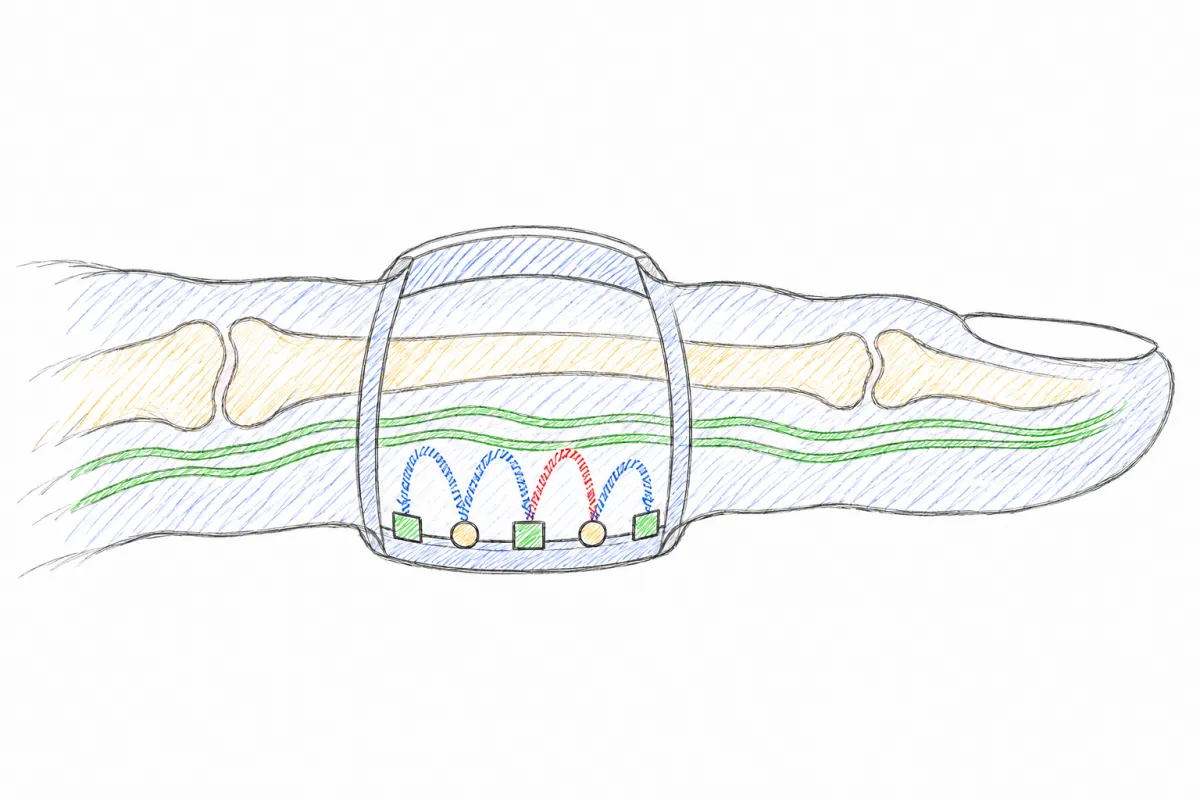
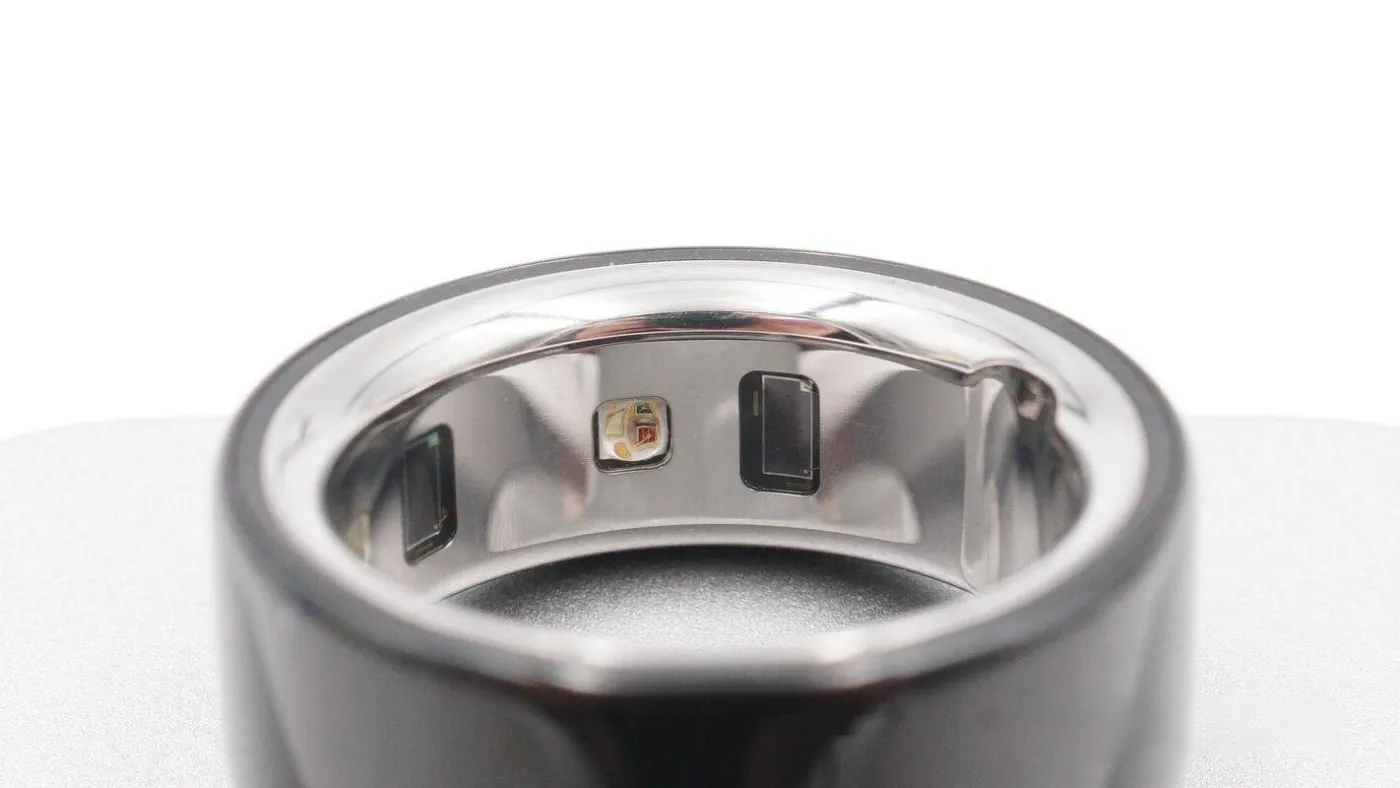
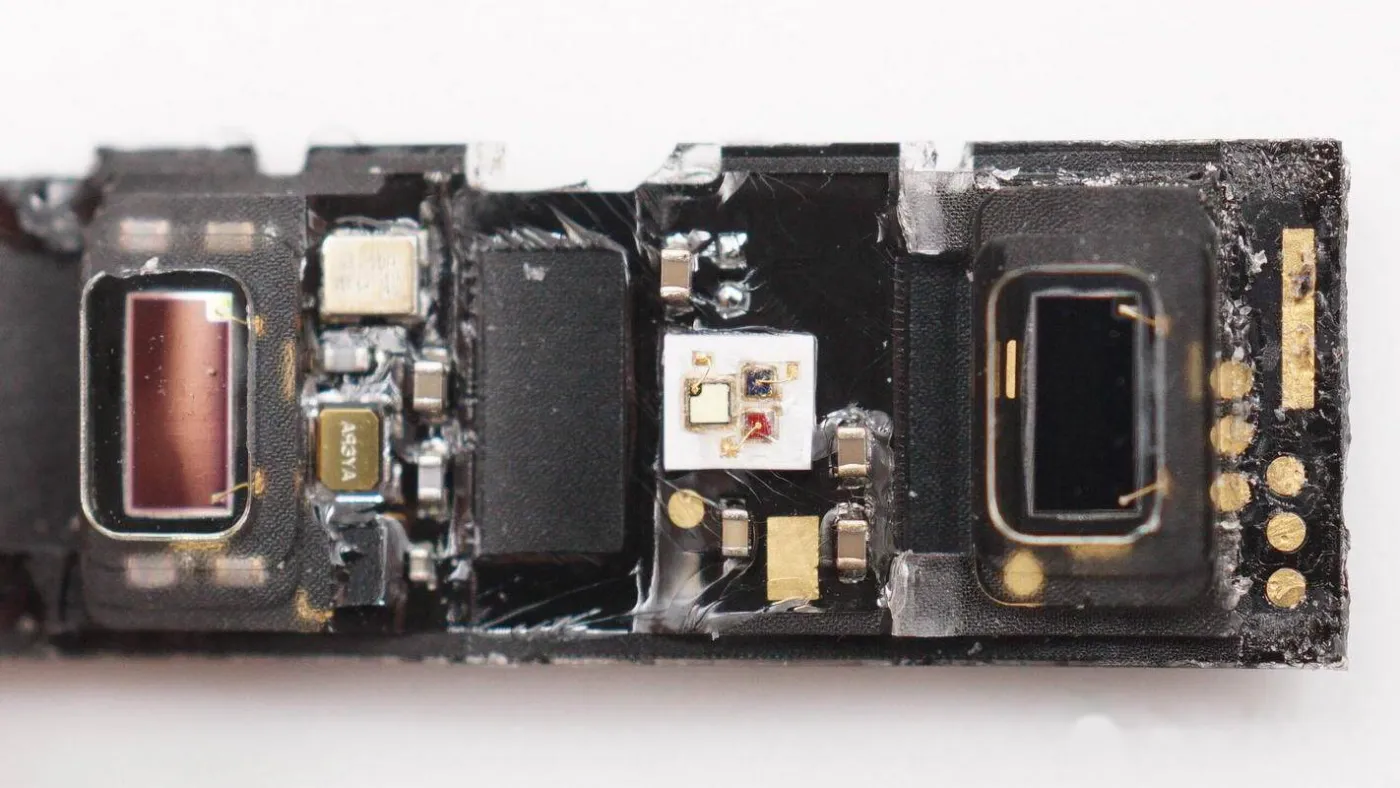
The Gen 3 ring had two green LEDs, a red and infrared LED and two detectors. The Ring 4 has two LEDs that each carry several colours and three detectors around the band, and Oura says this gives 18 signal paths, up from 8; two LEDs, three detectors and three colours multiply out to exactly 18. The ring does not light every path at once. Oura calls the selection Smart Sensing: the firmware picks whichever paths give the cleanest signal on a particular finger, and can change its choice as the ring shifts.
Finger vs Wrist
Each finger is fed by small arteries running along its sides, which branch into a dense bed of tiny vessels just under thin skin, with little fat or tendon between them and the sensor. At the wrist the arteries lie deeper, among tendons and bone, and a strap slides over the skin as the wrist turns. In a 2019 study of 36 healthy adults, Hartmann and colleagues put the same optical sensor on six parts of the body and found the strongest pulse at the finger. The finger gave a usable waveform in 95% of recordings, the underside of the wrist in 86%, and the back of the wrist, where a watch sits, in 67%.
The difference shows up in consumer devices too. Dial and colleagues compared five wearables with a chest ECG over 536 nights from 13 healthy adults, and the two Oura rings matched the ECG’s overnight heart rate variability most closely.
The study is small, its participants were healthy and it measured only at night; a published reply also pointed out that each device averages HRV over a different part of the night, which makes a fair comparison harder. Each place has its strengths, and the finger’s advantage is clearest when the body is still.
Sources: Hartmann et al., Frontiers in Physiology, 2019; Dial et al., Physiological Reports, 2025. The comparison table is our summary of how each place behaves.
The Chips
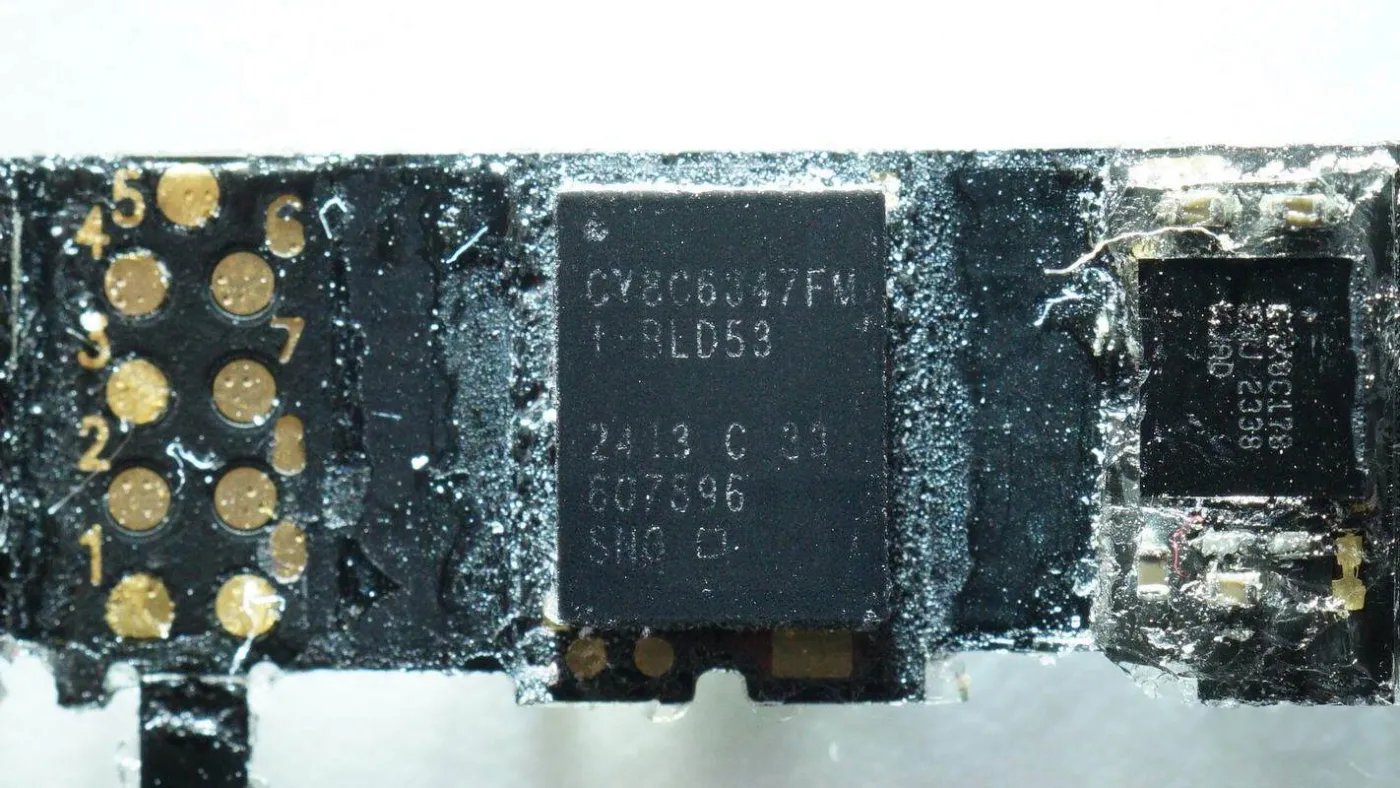
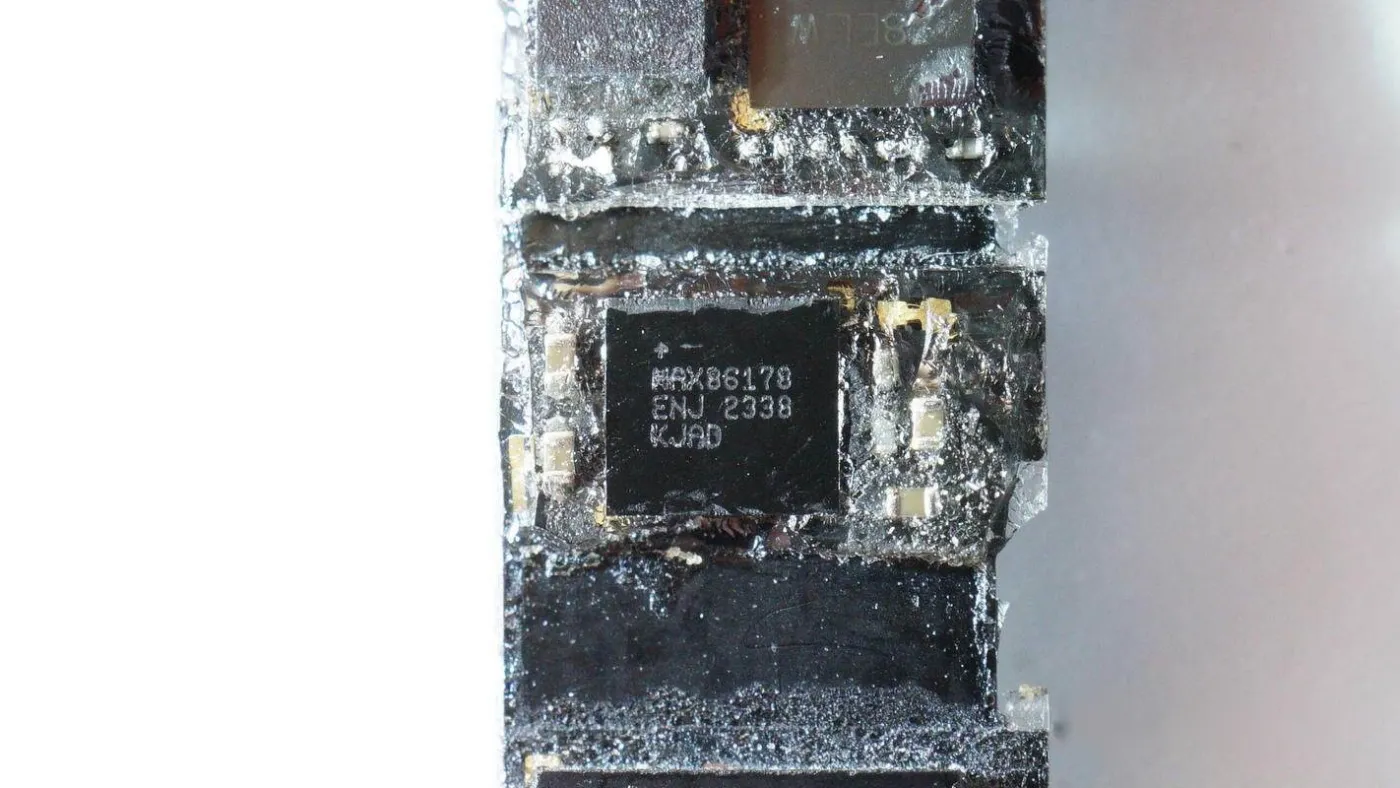
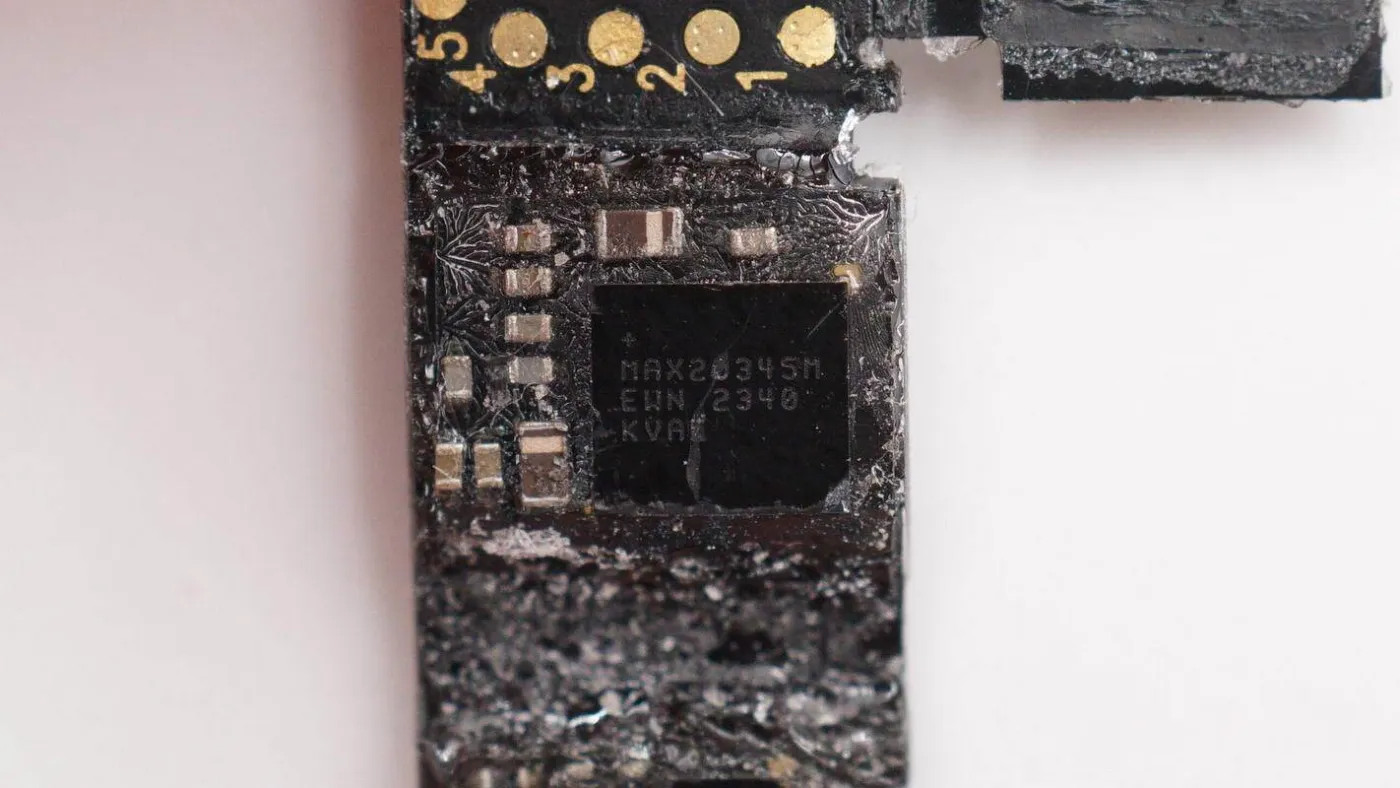
The ring’s brain is an Infineon PSoC 63, a microcontroller with a Bluetooth Low Energy radio built in, which runs the firmware, does the sleep analysis on the ring and talks to the phone. Next to it is the sensor front end, the Analog Devices MAX86178; it can also read heart signals through electrodes and measure the skin’s electrical resistance, though Oura does not offer either reading on this ring. The MAX20345, also from Analog Devices, charges the battery and supplies the rest of the board, with a separate adjustable supply for the LEDs.
Around them sit a motion sensor that TechInsights identifies as a Bosch part smaller than the BMI160 used in Gen 3, a memory chip, presumably for the log of readings the phone collects, and two crystals that keep time. Oura also lists a digital temperature sensor, which the photographs do not identify. TechInsights estimates that the microcontroller, the sensor front end and the power chip together make up about half the cost of all the chips in the ring.
- Microcontroller
- Infineon CY8C6347FMI-BLD53, PSoC 63 with Bluetooth LE 5.0
- Sensor front end
- Analog Devices MAX86178, for light-based pulse sensing, with electrode inputs unused
- Power
- Analog Devices MAX20345, charger and regulators with a buck-boost supply for the LEDs
- Motion
- Accelerometer marked “bHS”, a Bosch Sensortec part according to TechInsights
- Memory
- Chip marked “Z8ELW 2401”, maker not identified
- Optics
- Two multicolour LEDs and three photodetectors
- Timing
- A 32 MHz crystal and a second crystal
- Battery
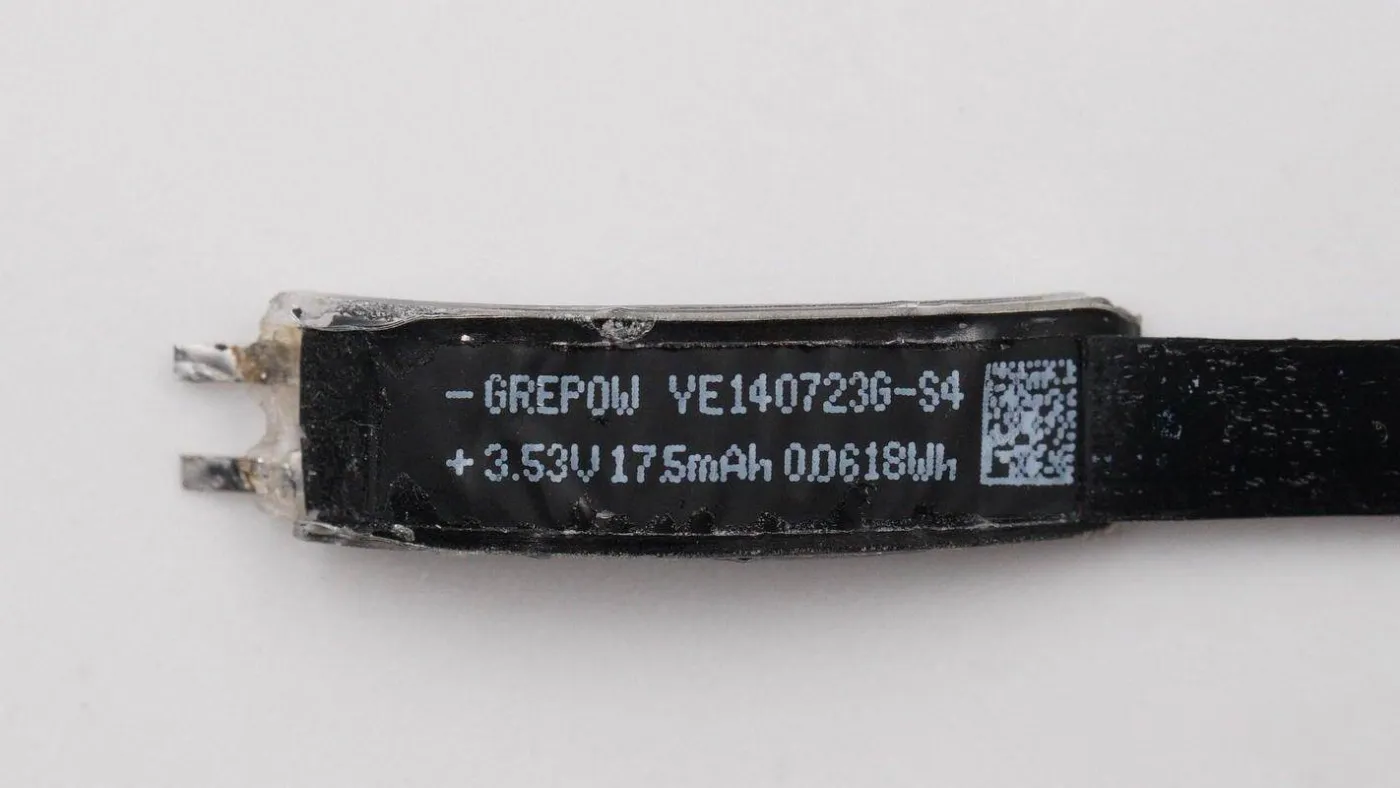
- Grepow YE140723G-S4, 17.5 mAh at 3.53 V nominal (size 7)
Sources: 52audio teardown, Jan 2026; TechInsights Oura Ring Gen 4 teardown summary, May 2025. That the electrode inputs are unused is our reading of the board and Oura’s feature list.
The Arc Battery
The battery is a long, thin lithium cell from Grepow, a battery maker in Shenzhen, shaped to follow the inside of the ring and fitted so closely that it leaves no room to spare. The one in this size 7 ring holds 17.5 mAh. TechInsights reports a 26 mAh cell in the Ring 4 it opened, without saying which size, and Becky Stern found a 16 mAh Grepow cell in a Gen 3 in 2022; the likeliest explanation is that a larger ring carries a longer cell, which would fit Oura’s estimate of five to eight days depending on size.
Charging
The ring has no metal contacts. A small coil sits behind its own window in the inner shell, and the dock charges it wirelessly through a coil wrapped around the post the ring slides onto, so there is nothing on the ring for sweat to corrode. Solid titanium would shield the coil from the dock, which is why it sits behind a window.
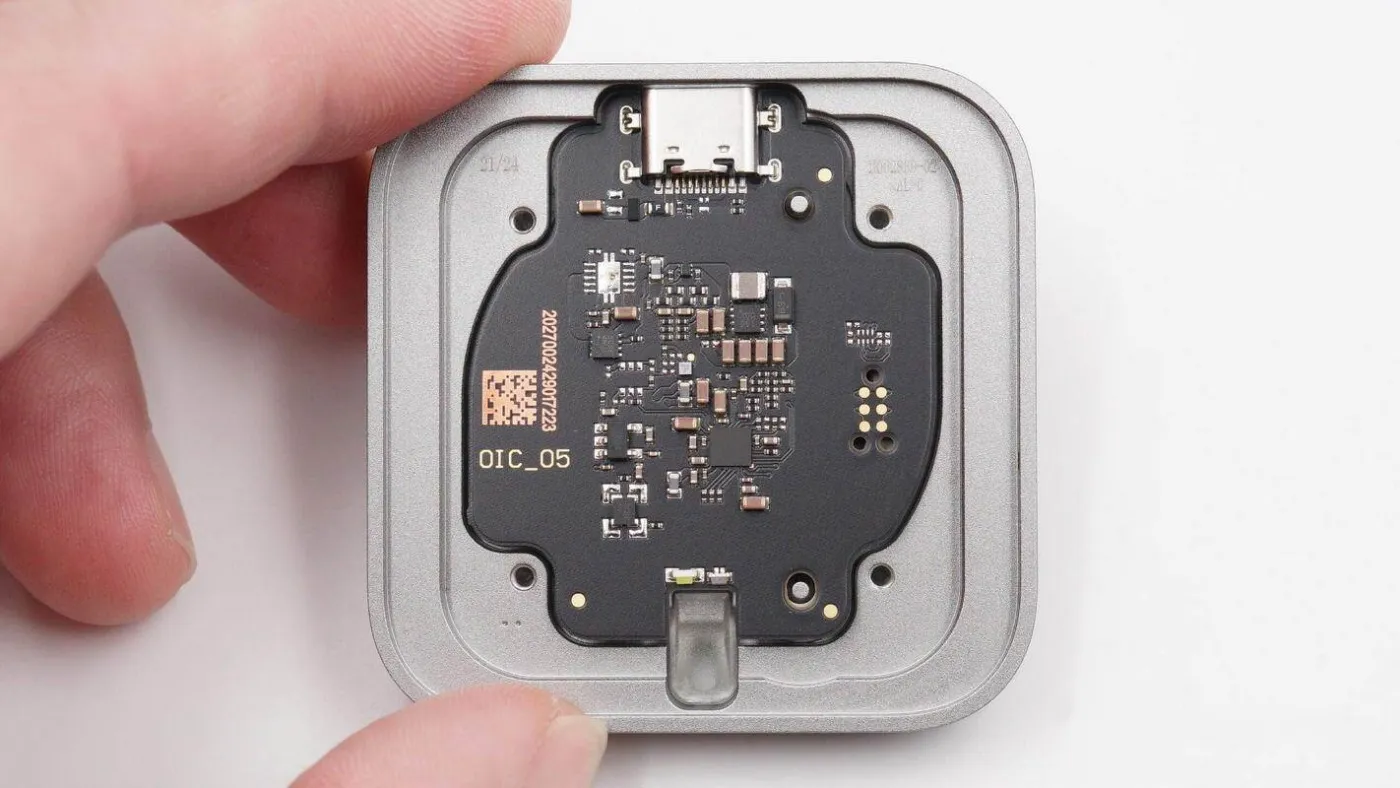
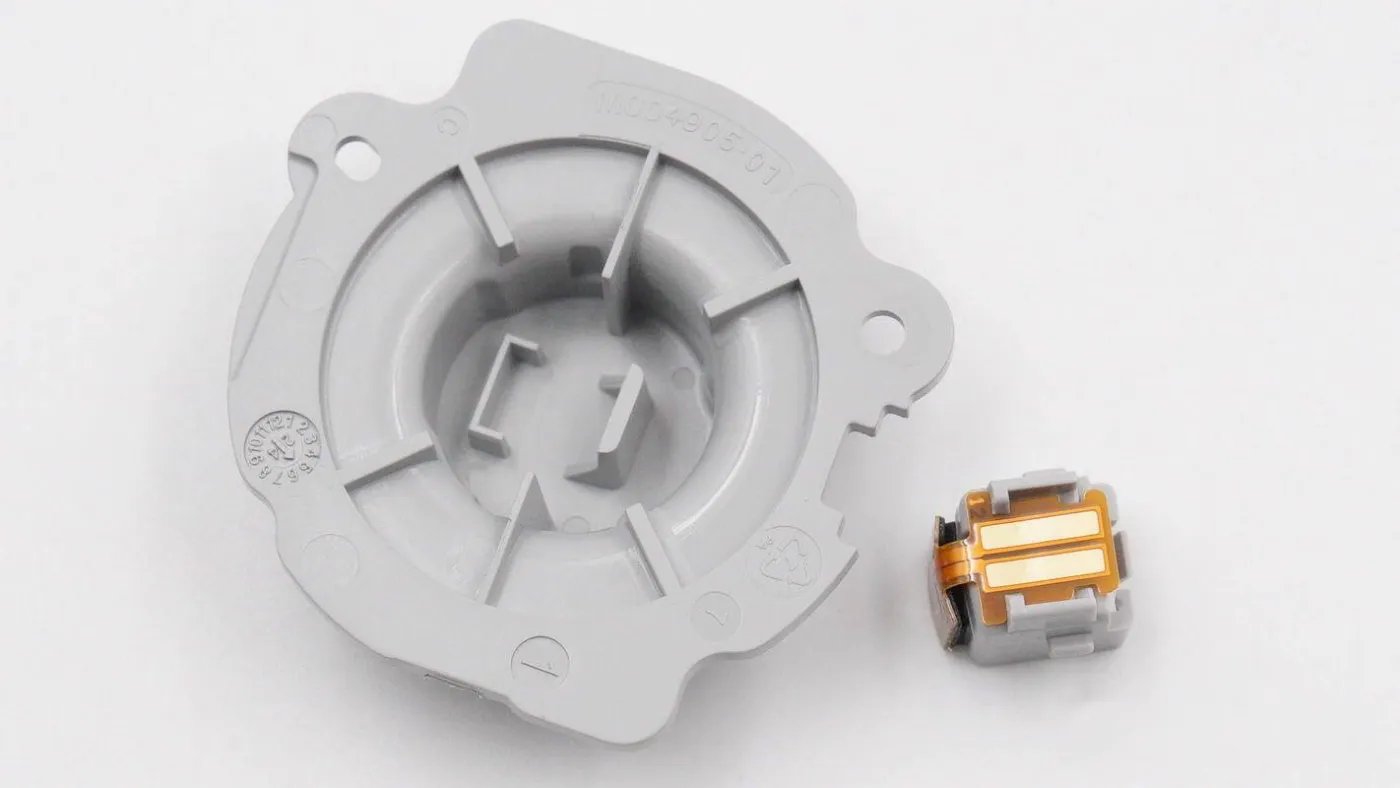
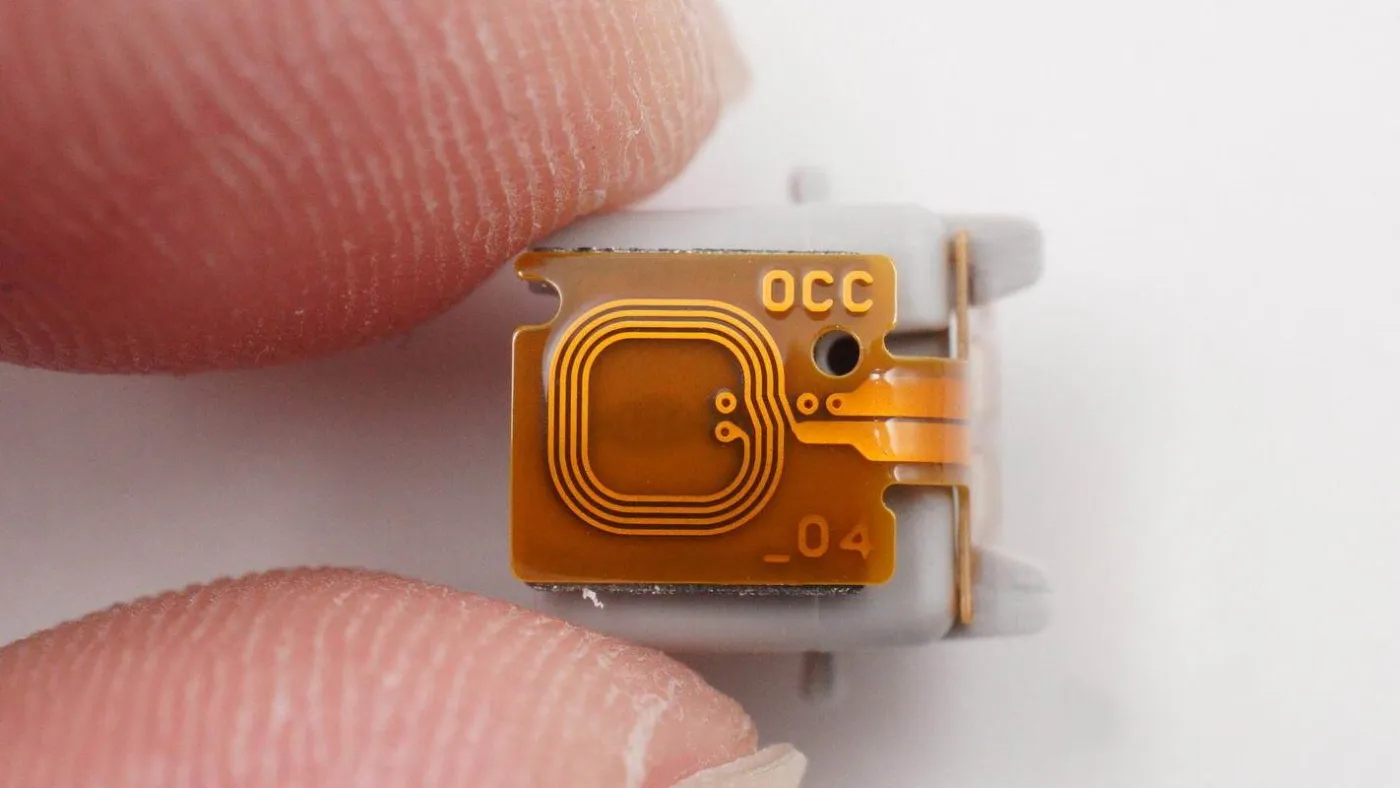
The dock takes power over USB-C and has its own Infineon microcontroller, a PSoC 61 without a radio, which controls the dock. Each dock fits only one ring size, presumably because the post has to fill the ring for the coils to line up. 52audio measured about 0.25 W from USB while charging, and Oura gives 20 to 80 minutes for a charge depending on how empty the ring is.
The Bluetooth Protocol
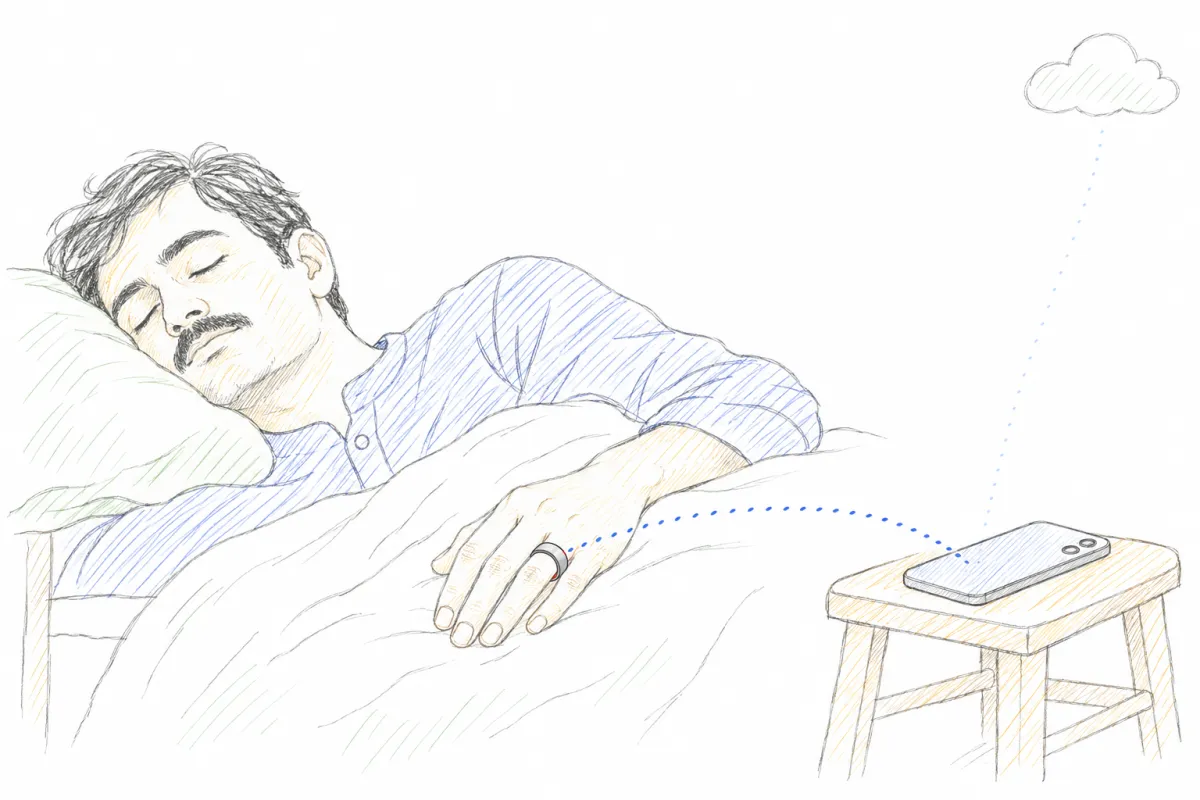
Several people have studied the Ring 4’s Bluetooth link in public, and their toolkits in Python, Rust and Zig can pair with a ring, sync its history and decode the readings without the Oura app or an Oura account. The most complete for the Ring 4 is open_ring, whose author reports decoding 953,206 records from 40 captures with no errors.
- A 15-byte challenge
- The challenge, encrypted with the 16-byte pairing key (AES-128)
- The event log: beat-to-beat intervals, skin temperature, motion, oxygen, HRV
With a ring already set up in the Oura app, the pairing key has to be recovered from your own phone’s app data, which on an iPhone is in a normal computer backup. None of these projects get around the key or change the ring’s firmware. The ring keeps one connection at a time, so the Oura app and an independent client take turns.
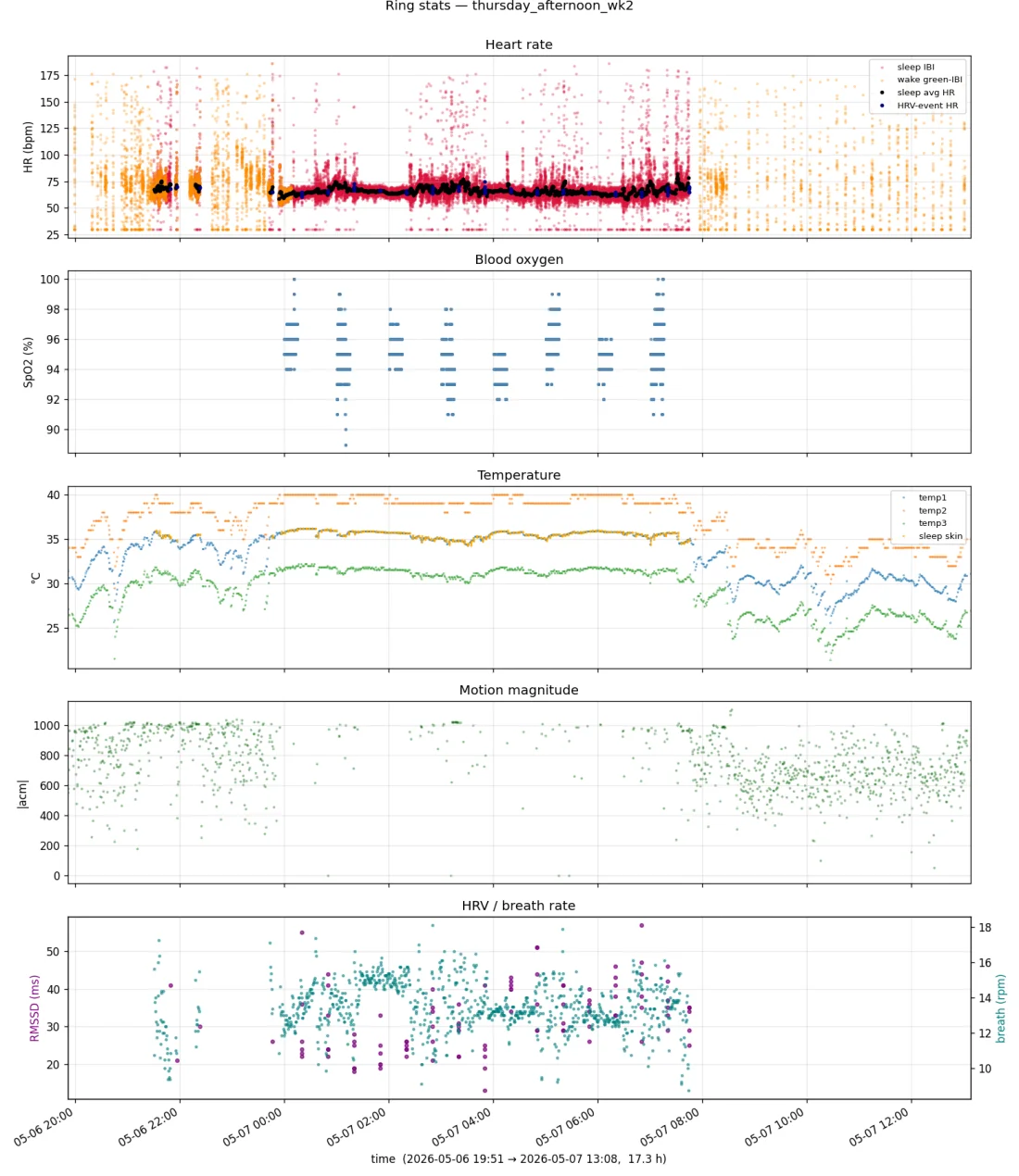
This is what comes off the ring when it is read directly. The author of open_ring synced their own Ring 4 over Bluetooth and plotted an evening, a night and a morning: heart rate from the beat-to-beat intervals, the blood oxygen readings the ring takes in bursts through the night, several temperature channels, motion, and five-minute HRV with breathing rate. The oxygen and HRV readings appear only while the wearer is asleep, and the temperatures fall once they are up and about. None of this needed the Oura app or Oura’s servers.
Where the Scores Come From
It is easy to assume that the scores come back from the cloud. The open_oura project found in the Android app that most of the work happens on the ring and the phone.
-
Ring
- Sleep stages, the hypnogram
- Minutes of activity at each intensity
-
Phone
- Sleep, readiness and activity scores, in a native library
- Stress, resilience and cardiovascular age, from encrypted models
-
Cloud
- Storage and sync
- The key that unlocks the models
- Workout types, the one step found only here
So the membership is a question of access more than computation: the raw readings are already on the ring and the phone. Oura lets its users export their data, and Cracked Oura, an open-source app, simply charts that export on a computer.
Open Health shows how far this goes. It syncs straight from the ring, works out sleep, activity and HRV on the phone, and asks for the ring’s pairing key in place of an Oura login.
The firmware itself travels to the ring encrypted with a key kept inside it, so these projects work only through the protocol the ring already speaks.
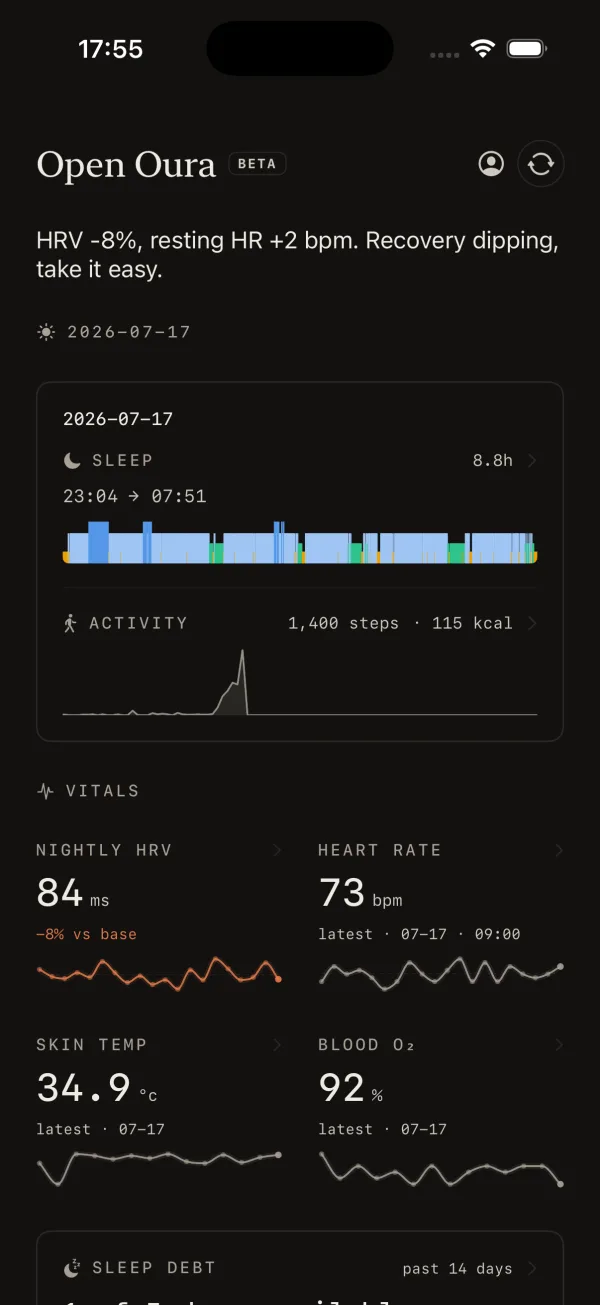
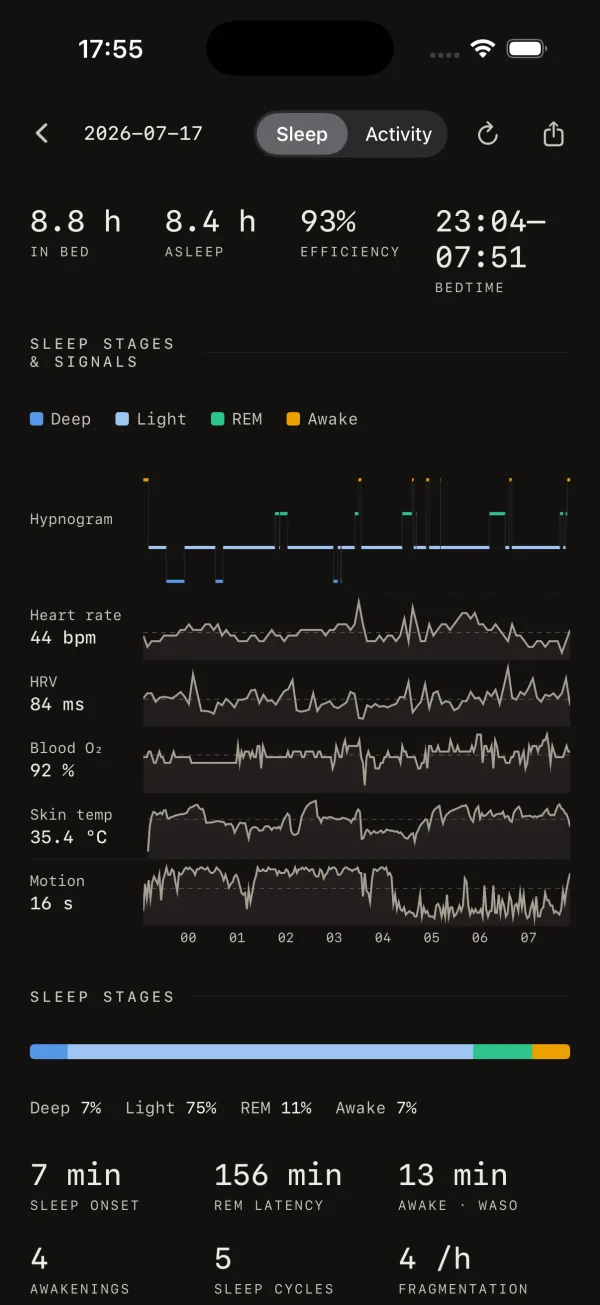
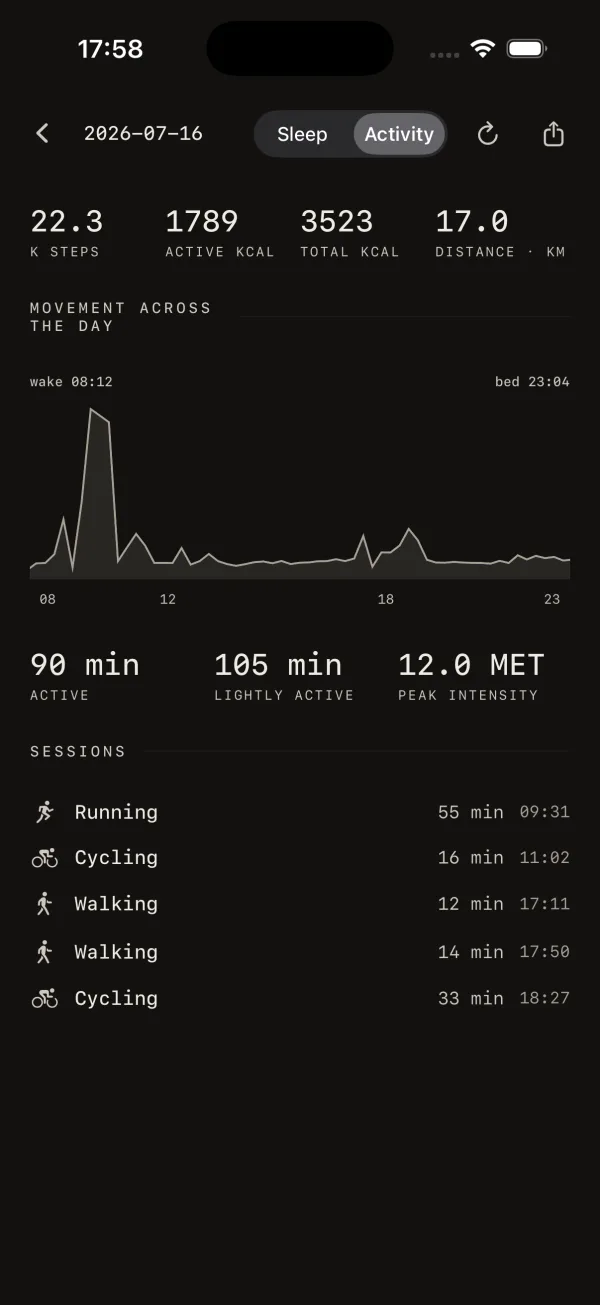
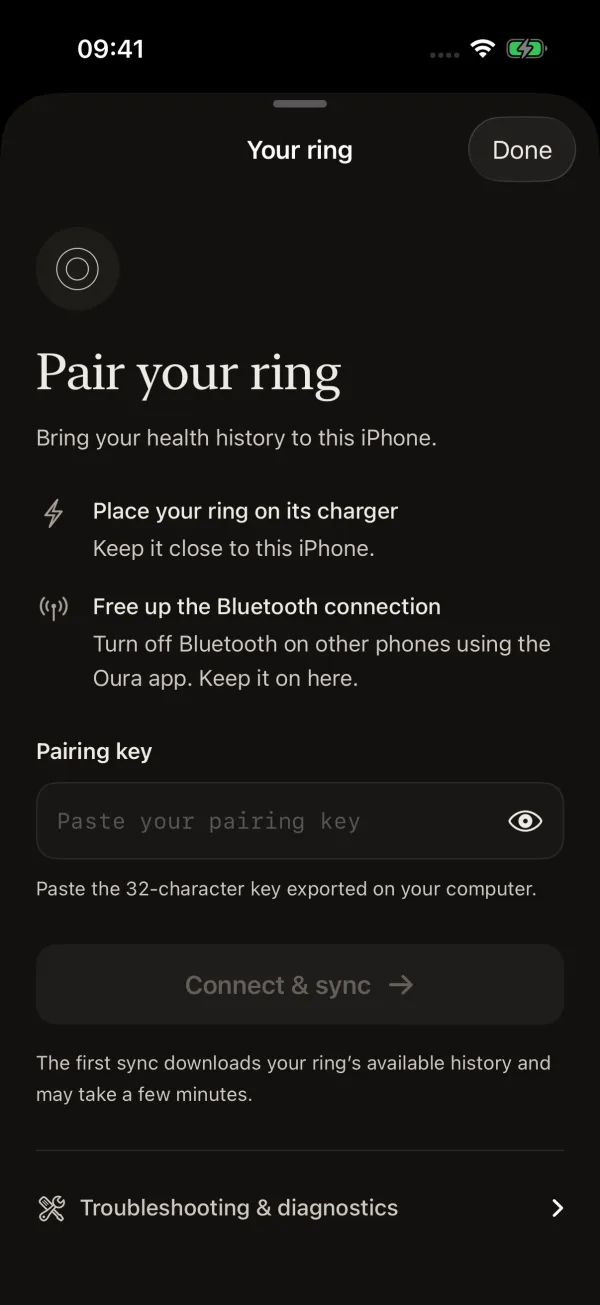
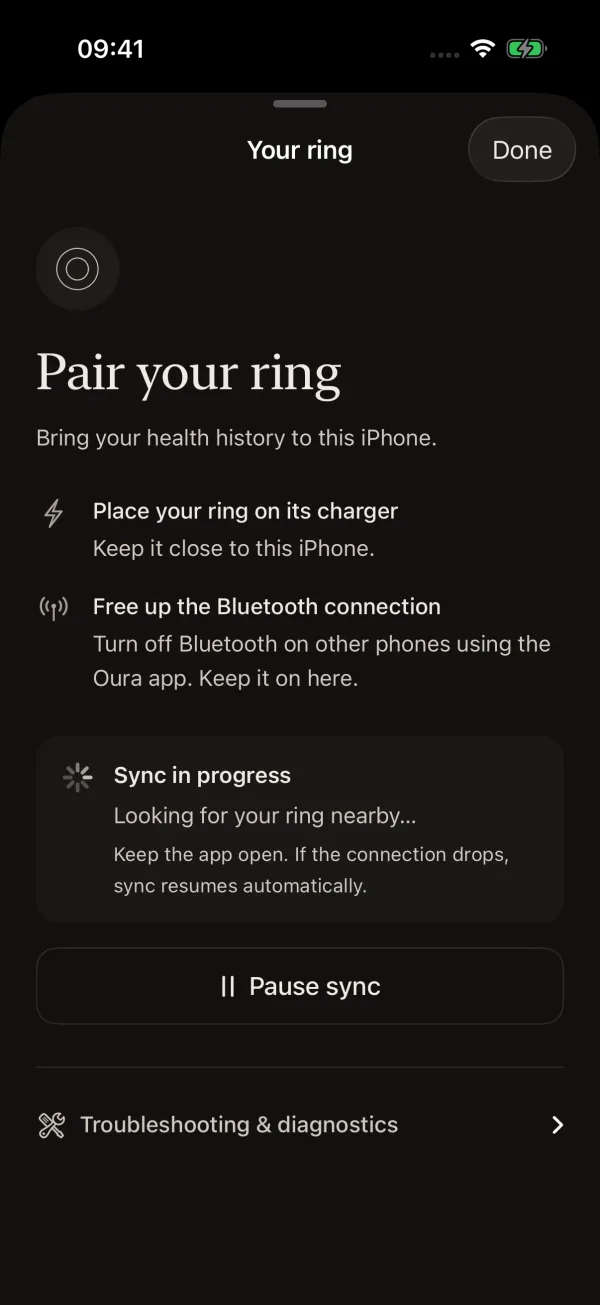
Open Health, an iPhone app built on open_oura, showing a Ring 5’s data with no Oura account, July 2026. Screenshots: Open Health, MIT.
Making One in India
Nothing in the ring’s bill of materials is exotic. Its chips can be bought in single units with public datasheets, and the hard work lies elsewhere.
Can be bought
- Microcontroller
- Sensor front end
- Power chip
- Motion sensor
Has to be learned
- Titanium shells, machined in twelve sizes, with resin-filled windows
- Curved cells, about 17 to 26 mAh, a different length for each size
- Folding and potting, water-resistant to 100 m
- Docks, one for each ring size
- Algorithms, that hold up across skin tones
- Validation, against clinical references, published openly
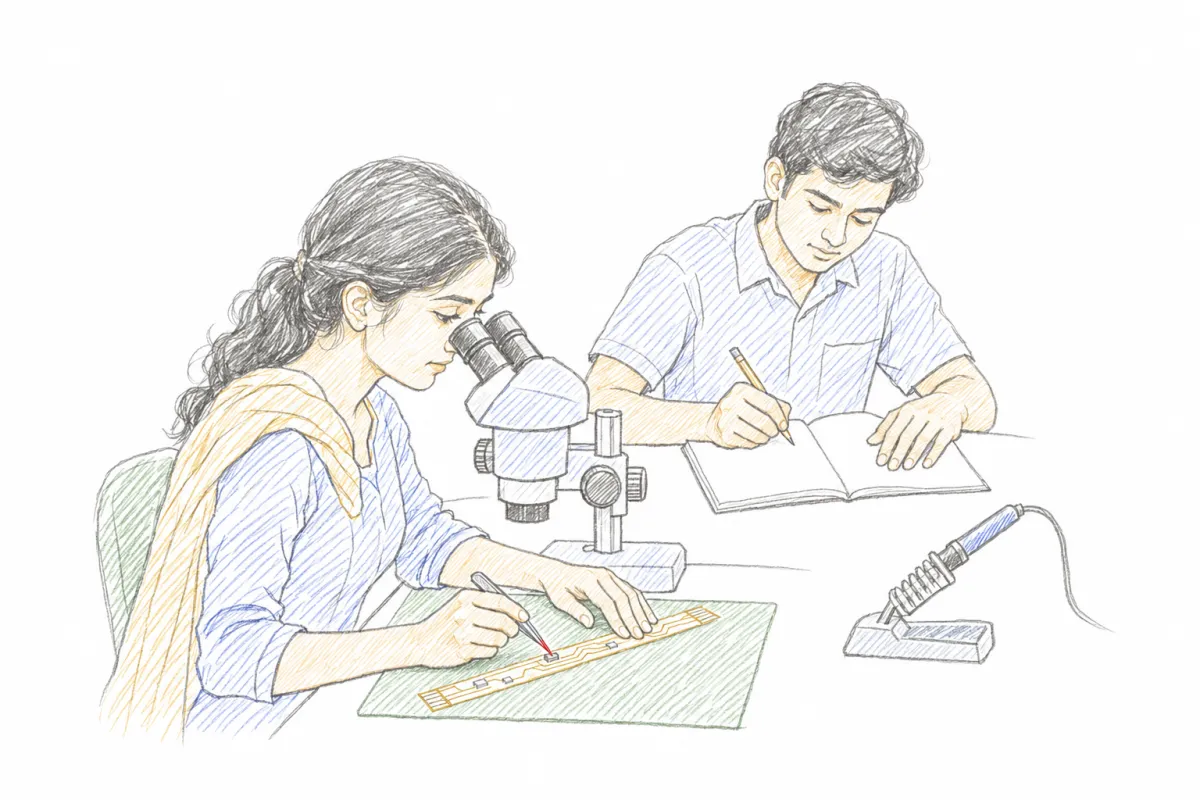
Het Bhavsar has written about how much of the smart rings sold under Indian brands is actually made in India. The shell, the cell and the signal processing are where the real work is, and where we believe a community that publishes everything could make progress.
Open Questions
These are the open questions we would like to settle, most of them by opening a ring ourselves.
As of 18 Nov 2026.
At a Glance
- Size
- Sizes 4 to 15; 7.9 mm wide, about 2.88 mm thick; 3.3 to 5.2 g
- Build
- Titanium outer and inner shells, resin-filled, sensors recessed 0.3 mm
- Sensors
- Two multicolour LEDs (green, red, infrared), three photodetectors, accelerometer, temperature sensor
- Chips
- Infineon PSoC 63, Analog Devices MAX86178 and MAX20345, Bosch accelerometer
- Battery
- 17.5 mAh in a size 7; five to eight days by Oura’s estimate
- Charging
- Wireless, on a size-matched dock with USB-C; 20 to 80 minutes
- Radio
- Bluetooth Low Energy; one connection at a time, authenticated with a 16-byte key
- Water
- Resistant to 100 m
- Price in India
- ₹28,900 for the ring, ₹599 a month for the membership, March 2026
Sources: Oura Ring 4 specifications; 52audio teardown; TechInsights; launch coverage in Digit.
Sources
- TechInsights, Oura Ring Gen 4 teardown, 22 May 2025, public summary.
- Finger and wrist: Hartmann et al., Quantitative comparison of photoplethysmographic waveform characteristics: effect of measurement site, Frontiers in Physiology, 2019; Dial et al., Validation of nocturnal resting heart rate and heart rate variability in consumer wearables, Physiological Reports, 2025, and the reply on comparing wearables.
- Becky Stern, Oura Ring teardown (Gen 3 and Gen 2), 2022.
- Oura: Oura Ring 4 specifications, Smart Sensing.
- Price in India: Digit, Oura Ring 4 launched in India, March 2026.
- Protocol: ringverse/protocol, open_ring and its protocol specification, open_oura with its notes on the app, where data is computed, firmware updates and security; open_health, zig-oura, oura-ring-ble, Cracked Oura.
- Teardown: 52audio, 16 Jan 2026, a size 7 titanium ring.
The count of 18 paths as two LEDs by three detectors by three colours is our arithmetic. This post is an independent account and is not affiliated with or endorsed by Oura. We describe these protocol projects; we haven’t run them, and using them may affect your warranty or your ring’s pairing with the Oura app.